
Freedom From Want?
Freedom from Want? Weekly Words Of Wisdom! (WWOW!) #01
'I think everybody should get rich and famous and do everything they ever dreamed of so they can see that it's not the answer.’
- Jim Carey
“Shame your mind, don't shine like your possessions do.”
Faithless lyric from the song “I Want More”
“Wealth consists not in having great possessions, but in having few wants.”
- Epictetus
Ever found yourself earning money by doing a job you hate, to buy things you don’t need, to impress people you don’t like? Seduced by mere hedonic immediate gratification masquerading as need?
Me too.
What to do about the gravitation pull of materialism?
This is #01 of #52 new blog posts. I will send one each week for 52 weeks (i.e. a year in total) as part of my commitment to achieving the WWOW! factor: Weekly Words Of Wisdom!
With your encouragement I might even collate them into a little book?
* Before I get a little “philosophical & intellectual” it seems wise to contextualise this musing on materialism. I’m very aware that in the UK & beyond many of us struggle to pay our rent or bills and not everyone gets to eat 3 meals a day (I regularly run out of money). This mini-essay is not about trying to make the unacceptable acceptable. When 2 parents both in full-time employment need the support of food-banks to survive, this suggests that the way things are shared amongst ourselves is perverse and broken. Feeding and clothing ourselves and those we love is genuine need not want or an unhealthy relationship with material possessions.
This musing of mine is me “thinking out loud” about my own struggle with delineating between my wants and needs. I don’t wish to have an opinion about others’ relationships with the material world. Arguably most research is “me-search”. I too love shiny things. I simply hope that sharing some of my ideas not only helps me but might be of benefit to you too. If not, no harm done. Live and let live.
So what do I need to not just survive but to thrive?
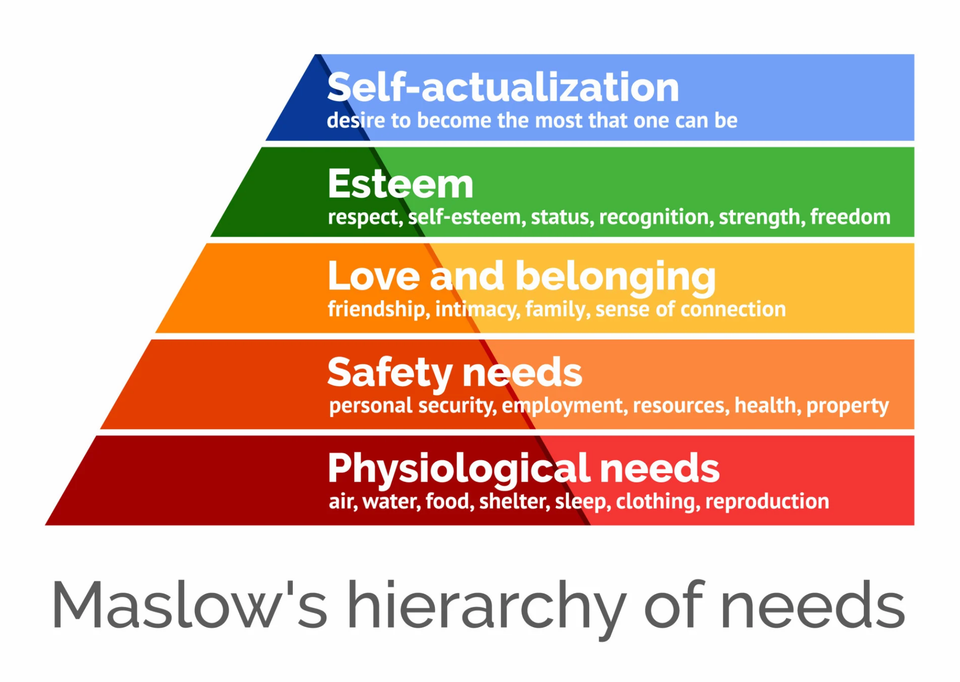
Maslow’s Hierarchy of Needs is a psychological theory proposed by Abraham Maslow that suggests human motivation is driven by a progression of needs, arranged in a pyramid structure from the most basic to the most advanced. At the base are physiological needs—such as food, water, shelter, and rest—followed by safety needs like security and stability. Once these are met, individuals focus on love and belonging, seeking relationships, connection, and community, and then esteem needs, including self-respect, recognition, and achievement. At the top is self-actualisation, the pursuit of personal growth, creativity, and fulfilment of one’s potential. Maslow argued that higher-level needs become a priority only after lower-level ones are reasonably satisfied, highlighting a natural progression toward psychological well-being and self-development. The key idea is we need to have the base of the pyramid in place until we can really excel and find contentment.
Having lots of lovely stuff so nearly scratches the itch of want doesn’t it? It’s hard not to obsess over something that so nearly works.
The problem is I can never get enough of what I don’t really need.
A funnier man than I made the observation that trying to get satisfaction from the material world is like taping sandwiches to your legs as a way to satiate your hunger.
I love a bit of Greek Philosophy and my favourite chap is Diogenes.
Diogenes was almost the archetype of anti-materialism — not just in theory, but in a way that was deliberately shocking to his contemporaries. His entire life was a protest against the belief that possessions, wealth, or social status were necessary for a good life.
Radical Simplicity
Diogenes owned almost nothing — just a cloak (he folded it so that it could double as bedding), a staff, and a small bag. He chose to live in a large storage jar in the marketplace of Athens. He famously discarded his drinking cup after watching a boy drink water from the hollow of his hands, saying that he was not aware until that moment that "nature had already provided him with a cup.”
Freedom Through Detachment
For Diogenes, possessions were not just physical burdens but also emotional chains. By needing almost nothing, he became immune to bribery, flattery, or fear of loss. The fewer things you depend on, the less control others have over you.
Rejecting Social Status as a False Measure
He mocked the pursuit of luxury and the people who equated wealth with worth. When Alexander the Great visited him and offered to grant any wish, Diogenes famously asked that he only wanted that Alexander: “Stand out of my sunlight.” Diogenes suggested that true worth comes from inner self-sufficiency, not from pleasing the powerful or owning more.
Living According to Nature
Diogenes believed most human misery came from living in artificial conformity to social expectations, including those around wealth. He sought a life guided by natural needs — food, shelter, companionship — without the excesses of luxury. Aligning life with genuine human needs cuts through the illusions that fuel materialism.
Public Provocation as a Mirror
Diogenes often behaved in ways society found outrageous — eating in the marketplace (and other socially unacceptable things!), sleeping in a barrel, even mocking rich citizens to their faces. These provocations were meant to expose the absurdity of conventional values, especially the obsession with wealth. Sometimes it takes bold, uncomfortable truths to wake us from the dream of materialism.
Diogenes teaches that materialism enslaves not only through the effort of acquiring possessions but through the fear of losing them. Radical independence can be achieved through reducing needs to the essentials — brings a kind of freedom and dignity that wealth can never buy. His life asks me to consider whether our possessions serve me, or whether I have become their servant?
Arguably Diogenes took the idea of not needing things to an extreme.
Let’s turn to the buddhist who specialise in seeking “the middle way”.
*Please note: Other religions are available! :)
The Buddha did not advocate extreme poverty or extreme indulgence, but a balanced life free from the compulsive pursuit of wealth. Buddhism approaches materialism as a symptom of attachment — one of the core causes of human suffering according to the Four Noble Truths. Rather than condemning wealth outright, Buddhist teaching focuses on how clinging to possessions, status, or sensory pleasures binds the mind to a cycle of craving and dissatisfaction.
Buddhists suggest all physical possessions are impermanent. Clinging to them is like holding on to water — eventually, it slips away. A case in point: you never really own an umbrella. You buy one and call it “mine”. But it is only a matter of time until you leave it on a bus or a train. You only ever really borrow possessions. The more we depend on impermanent things for our identity or happiness, the more we set ourselves up for disappointment.
Giving freely is considered an antidote to materialism by Buddhists. By practicing generosity without expectation of return, the grip of craving is loosened, and compassion is strengthened. Material possessions are not inherently wrong, but the attachment, craving, and identification with them create suffering. Freedom comes from understanding impermanence, loosening clinging, practicing generosity, and living with mindful balance — finding contentment in the present rather than chasing fulfilment through acquisition.
So what has writing this diatribe taught me?
Much of what I think I “need” is actually “want in disguise” and optional; simplicity can be liberating. Not that wanting per-se is bad, this isn’t about judging myself or anyone. But it is helpful to recognise that much of what I want isn’t that good for me and probably won’t solve the issues I think it will - I rarely fix my internal discomfort via changing my external circumstances.
My takeaway?
The less I need, the richer I am.
Like this post? Then please share on your socials! Sharing is caring!
buddi bench
Creative responses to human distress
Member discussion